SAFESEA co-develops science-based, stakeholder-driven knowledge, tools, and indicators to support inclusive decision-making on ocean acidification, from local case studies to global policy.
Image: Cold-water coral habitat off the west coast of Scotland taken during the JC073 Changing Oceans research cruise in 2012.
The Challenge
A changing ocean needs better evidence
Ocean acidification is changing the chemistry of the ocean, with consequences for marine ecosystems, biodiversity and the people who depend on them.
PH, GLOBAL SURFACE OCEAN — 1982–2024DATA: GRUBER & GREGOR, ETH ZÜRICH
AIM
To co-develop and deliver science-based, stakeholder-driven knowledge, tools, and indicators that support inclusive decision-making on ocean acidification in a multi-stressor context.
Enhancing marine ecosystem and community resilience from local to global scales.
Above: The difference between urchins exposed to normal and acidified conditions.
SAFESEA at a glance
3
Focus Regions
6
Objectives
12
Partners
what we do
Six objectives, one shared goal
Produce scientific evidence
Via co-designed processes, ensuring decision-support tools are relevant and usable.
Address OA monitoring gaps
Including surface and interior ocean, coastal zones, and high-risk polar regions.
Identify biological thresholds
And indicators for OA in combination with warming, deoxygenation, and other drivers.
Enhance model skill and resolution
For OA projections and risk management.
Integrate OA into governance
Frameworks incorporating planetary boundaries, justice, and equity.
Communicate and build capacity
Targeted communication, exploitation, and capacity building for broad uptake.
Where we work
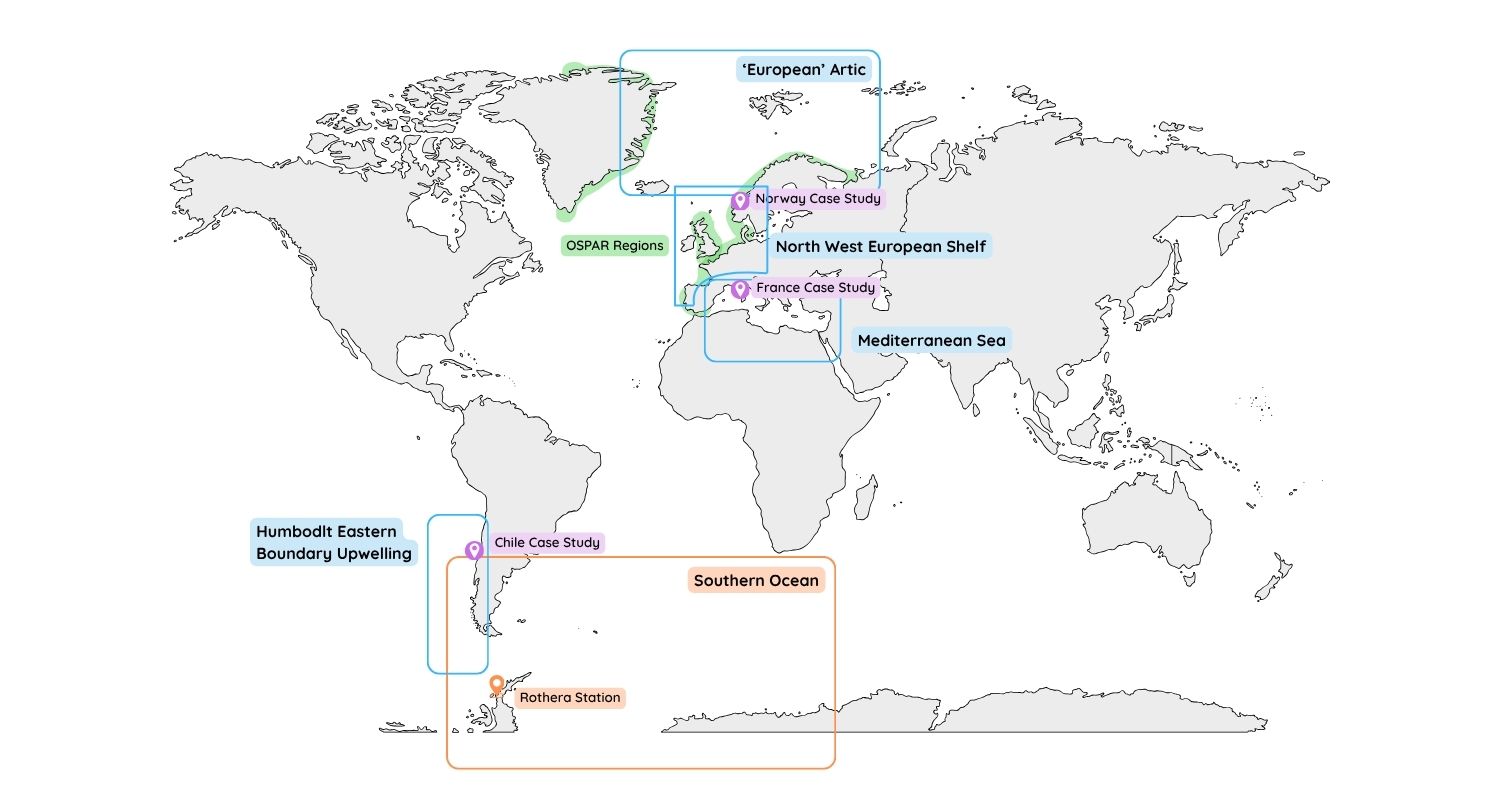
Focus regions and case studies
SAFESEA locations of interest
CASE STUDIES
Norway – Northwest European Shelf & European Arctic
France – Northwest European Shelf & Mediterranean Sea
Chile – Humboldt Eastern Boundary Upwelling
Regions
Baltic SeaOSPAR regionsMediterranean SeaEuropean ArcticSouthern OceanRothera Station
Work programme
From evidence to action
Six interconnected work packages bring together observations, science, modelling and stakeholder knowledge to understand and respond to ocean acidification.
WP1 — Stakeholder Co-Design, Communication, and Impact
WP2Integrating OA into observation & monitoring frameworks
WP3Drivers, variability, and impacts of OA under multi-stressor contexts
WP4Improved integration of OA knowledge into modelling